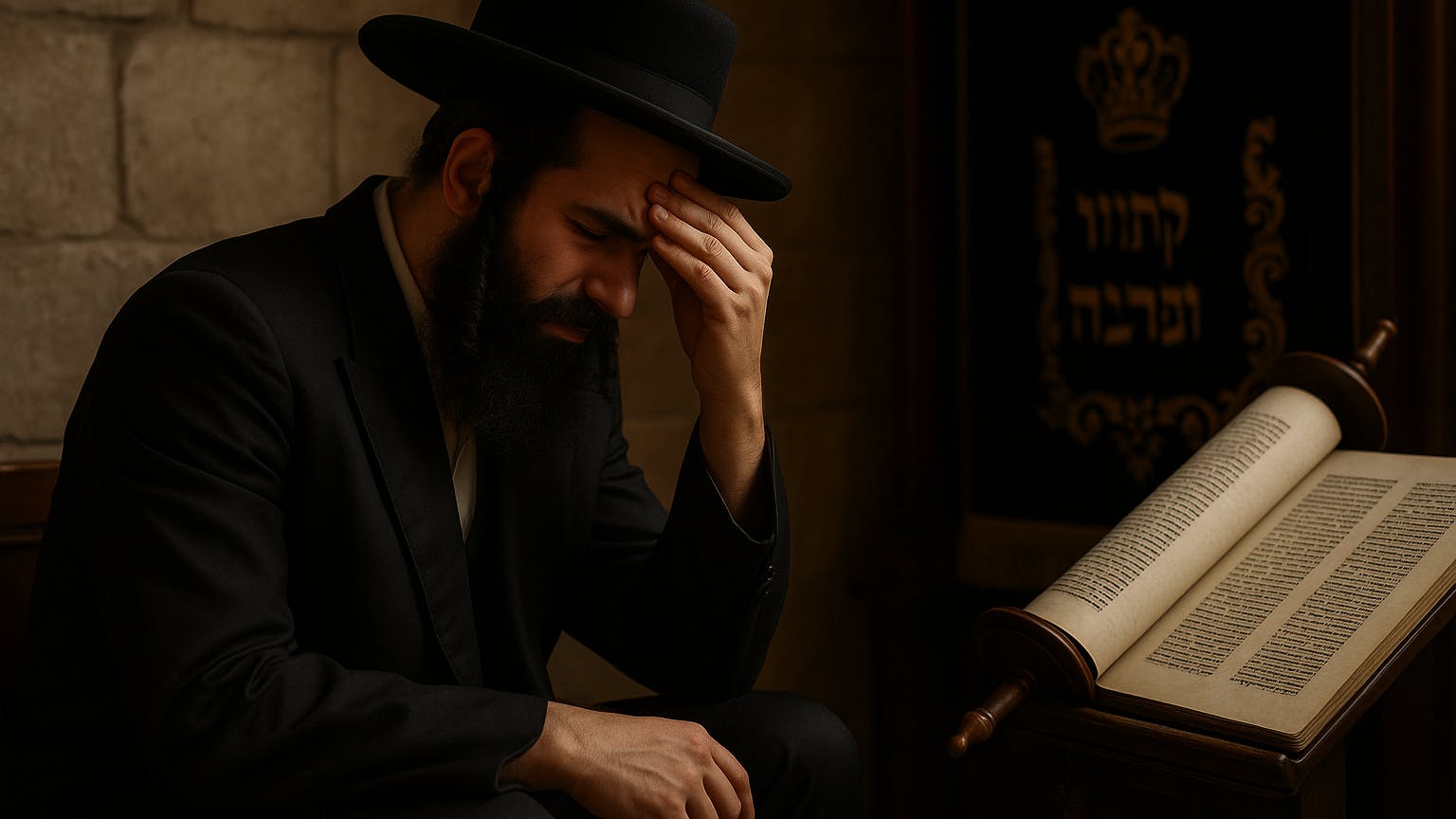
The Universal Corruption of the Human Heart
The Torah describes the human condition in strikingly honest terms. After Adam’s transgression, the LORD declares:
“God saw that the wickedness of man was great in the earth, and that every imagination of the thoughts of his heart was only evil continually.” (Genesis 6:5).
This prompted him to send the worldwide flood, killing everyone except Noah and his family: Noah having found grace in the eyes of the Lord (Genesis 6:8). The problem is not superficial; it is internal. The human mind was universally darkened because of the fall, affecting every single person born since Adam and Eve’s sin. The effects of sin clearly reached into every thought of the mind, and also the whole heart in its choosing and loving. After the flood, God confirms:
Genesis 8:21
The imagination of man’s heart is evil from his youth.

The Prophets expand on this truth:
Jeremiah 17:9
The heart is deceitful above all things, and desperately wicked.
Blindness to spiritual truth, then, is not surprising. Isaiah declares that God Himself judicially blinded Israel in judgment and mercy:
Isaiah 44:18
He hath shut their eyes, that they cannot see; and their hearts, that they cannot understand.
And again:
The Purpose of the Torah: To Reveal Our Need for Messiah
When God gave the law to our forefathers on Sinai, the purpose was for our people to see how it required complete and perfect obedience:
Deuteronomy 6:5
With all thine heart, and with all thy soul, and with all thy might.
Yet the Torah itself shows that no descendant of Adam can keep this perfectly. The Law is holy—but we are not. Its purpose, therefore, is not only to instruct, but also to expose and convict, so that Israel would long for the Messiah who alone could fulfill it.
The purpose of the law then was to drive the Israelites to their Messiah. The Prophets describe this Messiah with remarkable clarity:
- Born in Bethlehem — Micah 5:2
- Born of a virgin — Isaiah 7:14
- Pierced and poured out unto death — Isaiah 52:13–53:12
- Hands and feet pierced — Psalm 22:16
- Rising from the dead — Psalm 16:10
- God and Man — Isaiah 9:6 with everlasting origins — Micah 5:2
- Appearing before the Second Temple’s destruction — Daniel 9:24–27
The Prophesied Rejection: The Stone the Builders Refused
One of Israel’s most beloved psalms (still read and sung in synagogues today) contains a startling prophecy:
Psalm 118:22–23
The stone which the builders refused is become the head stone of the corner.
When we put that together with the words of Isaiah that the hearts of the people would be made fat—words applied by Jesus Christ to his unbelieving Jewish audience in the gospel—it starts to fall into place why the Jewish missed the obvious fulfillment of Messianic prophecy. God forewarned the Jewish people that they themselves would not recognize their own Messiah.
The Messiah would not only be missed—He would be refused by the very leaders expected to recognize Him. The “builders” are those who handle the Torah.
This rejection was not accidental. It was foretold. It is not evidence against Jesus being the Messiah. It is evidence for it.
Not a Puzzle to Solve, but a Person to Engage
Old Testament prophecy is not merely a puzzle to solve by intellectual deduction, matching predictions to events to identify the Messiah. Jesus did not merely fit the description, he preached in a way that pierced men’s hearts, telling his hearers to “Repent and believe the gospel” (Mark 1:15).
Many Jewish leaders hated him for his preaching, healing, and exorcizing of demons, prompting one of the scribes from Jerusalem to falsely claim: “He hath Beelzebub, and by the prince of the devils casteth he out devils.” (Mark 3:22). This was not a mere mistake in assembling the evidence by these religious leaders, but rather, a wilful rejection of Jesus and his gospel.
Jesus Reveals the Heart’s True Condition
When a wealthy ruler insisted he kept all the commandments, Jesus replied:
Matthew 19:21
If thou wilt be perfect, go and sell that thou hast, and give to the poor, and thou shalt have treasure in heaven: and come and follow me
The man walked away sorrowful, as he was loath to do so, Jesus had exposed the lingering corruption in his heart.
The rabbi Nicodemus came to Jesus at night, and could not grasp the need for spiritual rebirth that Jesus explained. He exclaimed: “How can these things be?”, prompting Jesus’ reply:
John 3:9–10
Art thou a master of Israel, and knowest not these things?
The issue is not intellect, but regeneration.
Humility vs. Pride: What God Seeks
Having misunderstood the purpose of the Torah, our forefathers wrongly thought—and continue to think—that they would be accepted by God through their acts.
Yet as Jesus taught in a parable, God is looking for humility and repentance from those brokenhearted over their sin, not pride from those who think they are wise.
Luke 18:10-14 reads: “Two men went up into the temple to pray; the one a Pharisee, and the other a publican. The Pharisee stood and prayed thus with himself, God, I thank thee, that I am not as other men are, extortioners, unjust, adulterers, or even as this publican. I fast twice in the week, I give tithes of all that I possess. And the publican, standing afar off, would not lift up so much as his eyes unto heaven, but smote upon his breast, saying, God be merciful to me a sinner. I tell you, this man went down to his house justified rather than the other: for every one that exalteth himself shall be abased; and he that humbleth himself shall be exalted.”
That is the heart of true repentance.
As Christ said elsewhere, “They that be whole [well] need not a physician [doctor], but they that are sick. But go ye and learn what that meaneth, I will have mercy, and not sacrifice: for I am not come to call the righteous [that is, those who falsely and pridefully think themselves righteous when they are not], but sinners to repentance. (Matthew 9:12-13).”
The Good News: What We Cannot Do, God Can
Left to ourselves, none of us—Jew or Gentile—can see the Messiah.
But Jesus gives hope:
Luke 18:27
The things which are impossible with men are possible with God.
The good news is that if you come to the Jewish Messiah Jesus Christ—believing his gospel, repenting of your sins, despairing of yourself, and wholly trusting in him—God will give you new life.
When a person turns to the Messiah in faith—repenting, believing, yielding—God opens the eyes that sin has closed and reveals what cannot be learned through study alone.
Come to the One foretold in Torah, honoured by the Prophets, and rejected by the builders—but exalted by God. Come to the Messiah of Israel and live.


More Topics
You might alsoo be interested in these topics.